Blackwell Parish 1851
For the second full census of Blackwell taken in 1851, we do not know the enumerator, and he/ she followed a different route around the parish; this is the description on page 1.

The Whole of the Parish of Blackwell including West Pasture, West House, Scanderlands, Newton, Hilcote and part of Little Moor
Households and Population
The table below shows that there was very little change between 1841 and 1851 in terms of numbers of households and residents of the parish, the total population decreasing by 9.
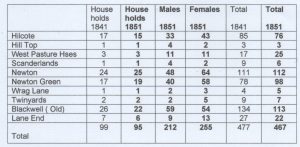
In 1851 no distinction was made between Newton and Newton Green, much as it is today, but later censuses revert to list both. Similarly the distinction between Lane End being Blackwell or Hilcote is uncertain, but a calculated estimate has been made based upon family names in order that a comparison between 1841 and 1851 may be made.
Included in Hilcote figures in the table above for 1851 is Pasture House which stood on the corner of Hilcote Lane and Berristow Lane ( Opposite side to The Hilcote Arms). Henry and Hannah Marple were farming 64 acres from there with their son John Henry. Pasture House was not identified as such in 1841 , although it does appear on an 1837 map. It was possibly occupied in 1841 by the Lomas family, who were the first farmers listed in 1841 and it is believed that the enumerators began at that location.
Family Names
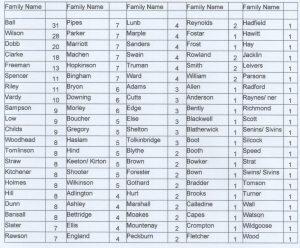
By 1851 the Ball families have taken the number one spot, and the Wilson families have leapt from mid division to second in the Premier League! Family names out altogether number 29 and new names 37. Notable newcomers are the Wilkinson Family into Hilcote and James Crompton into Newton. Stephen Wilkinson was born in Little Stretton Leicestershire, but had married a Blackwell girl Eliza Boucher in1846. His daughter Georgina by his first marriage was living with them and his son John Slater and Stephen Wilkinson are visitors staying with Eliza’s parents John and Margaret Boucher. James Crompton is lodging with the Gothard family in Town Lane Newton and is a Primitive Methodist Minister.
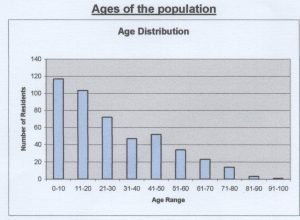
Ages of the population
Occupations
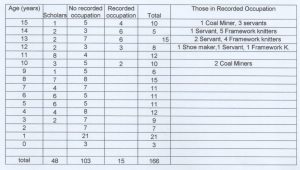
In this census there is more information regarding who is enjoying education ( if enjoy is the correct word). This table shows the age range 0 to 15 years and whether they are described as in Employment, are Scholars or neither.
Again it is possible that the reason for those without occupation is omission rather than fact, and/ or that over the age of 10 they are working in the home.
In any case 1851 shows a significant increase in numbers in education. The school in 1841 had places for only 12, so the increase to 48 indicates some increase in provision. The additional recording of Ann Gothard of Newton as a School Dame supports this. Note also that the Primitive Methodist Minister was a lodger with Thomas and Ann Gothard, so perhaps it is fair to assume that some of this increase in provision is through Methodist schooling in some form. Note that some 3 and 4 year olds were recorded as scholars.
The 1851 census also records 6 paupers and 2 retired in the population.
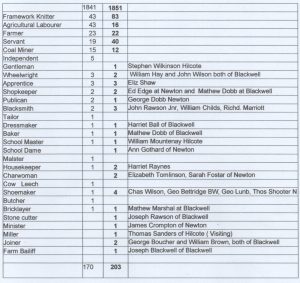 In terms of type of employment it can be seen that there has been a significant decrease in the numbers employed as agricultural labourers, although the number of Farmers has decreased only slightly. The increase in Framework Knitters could be caused by this decrease of employment on the land or the cause of it. Another explanation could be the redefining of some Agricultural labourers as Farm Servants.
Coal Mining remains a minor employment, with little indication of it’s future in the parish.
In 1841 George Ball was a publican at The Robin Hood Pub between Pipes Farm and Boucher House in Blackwell, but in 1851 he is not recorded as a publican. Perhaps at age 72 and now a widower, although still living there he had retired, signed the pledge or run out of beer!
In Newton in 1841, William Clark was a publican at The George and Dragon , but in 1851 he and family are still there but now described as a Farmer. In Town Lane George Dobb, living next door to the new Primitive Methodist Minister is now the only recorded “Retailer of Beer”.
New occupations to the parish are Stone Cutter, Minister, Miller, Joiner and Farm Bailiff.
Born in Derbyshire?
Of the population of 468 , 12 have no birth place recorded . 226 or 50% of the rest were born in Blackwell. 70 in neighbouring parishes of South Normanton, Tibshelf, Shirland and Huthwaite. 55 more within 5 miles of Blackwell, 86 in Derbyshire and Nottinghamshire with exact town or village unknown. Then we have a scattering of 5 from Yorkshire, 2 from Staffordshire and Leicestershire, and one each from Cambridgeshire, Cheshire, Lincolnshire, Warwickshire and 3 Southerners from Hampshire, Sussex and Dorset. And finally one born in Picardy France. So in total 96% of the population were Derbyshire and Nottinghamshire born, with at least 78% within 5 miles of Blackwell.