Blackwell Parish 1861
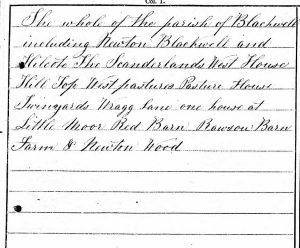 By 1861 the population had grown as the title on the first page indicates:
The whole of the Parish of Blackwell including Newton, Blackwell and Hilcote, The Scanderlands,West House, Hill Top , West pastures, Pasture House,Twinyards, Wragg Lane,one house at Little Moor, Red Barn, Rawson Barn Farm & Newton Wood
Households and Population
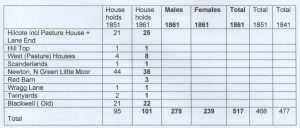
The most significant difference between 1851 and 1861 is the erection of 6 Huts for Railway Workers at West Houses. Dr Dudley Fowkes has made considerable research into this phenomenon. The census shows that these huts housed a population of 19 men, 8 women and 5 girls and 10 boys of 14 years and under. 2 of these boys are described as Railway Labourers, one at 14 years old and the other 6 years old.
All were incomers, only 1 being Derbyshire and 6 Nottinghamshire born. 6 are known to be born in Ireland, and the names and origins of 4 are recorded as unknown. 20 are Railway Labourers , 2 Bricklayers.
The head of each household in these huts also had a wife, who presumably undertook the household duties of cooking, cleaning and washing for the whole hut. Similar navvy encampments often had higher numbers of hard drinking single men, and fights with locals often resulted, as was the case in Belper. Perhaps the arrangement at Westhouses was to avoid such disputes. The 2016 TV drama Jericho is the story of Railway Labourers in a Shanty Town of similar huts in Yorkshire in the 1870s.
A further 12 men in the Blackwell census are shown as Railway labourers, many lodging , and some had moved into existing properties with their families. My own Great Grandfather and his brothers left agricultural labouring in Norfolk to become Railroad Navvies before settling in Nottinghamshire when the coal mines were sunk.
Family Names
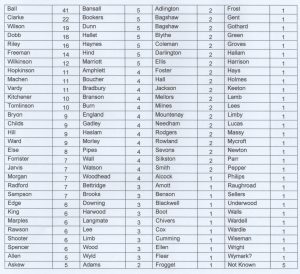
Within the 101 households there are 124 family names, including 4 unknowns, and 20 of the family names still account for 50% of the population. And the first 5 names , Ball, Clarke, Wilson, Dobb and Riley account for 20%.The table here shows all the family names with the numbers of those who bore the name. In the 10 years since 1851, the Dobbs have lost 9 from the parish, while the Balls have doubled their count. At the other end of the table there are 35 single or unmarried versus 29 in 1851.
The most popular Christian names in the parish were :Mary (42), Anne (40), Elizabeth (34) Sarah (25), Hannah (22) and John (56), George (46), William (44), and Thomas (22). These names account for 64% of the population.
Ages of the population
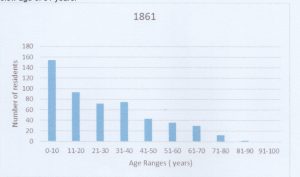
This chart shows the ages of the population in 10 year bands. 48% are 20 years and younger, 61% below age of 31 years.
Education and Occupation
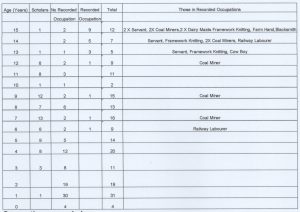
 76 children are described as Scholars from a total of 198 aged 0 to 15 years, another significant increase since 1851. None of the children in the Railway Huts are described as Scholars.There is one child of 6 recorded as a Railway Labourer, one 7 year old and one 9 year old as Coal Miners, indicating that they were probably working alongside their parents.
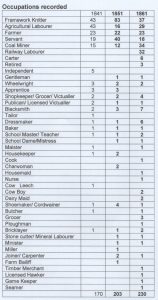
Occupations recorded:
Here there shows a signficant reduction in Framework employment, some going back to the land, and others into coal mining, probably in shallow mines. And the inclusion now of the Railway labourers housed in the huts at West House Farm.
Born in Derbyshire?
Of the population of 517, 233 were born in the parish, 118 elsewhere in Derbyshire, 94 in Nottinghamshire, 17 in Lincolnshire, 8 in Leicestershire, 6 in Yorkshire, 6 in Ireland, 5 in Sussex, 3 in France, 3 in Norfolk, 2 each in Cambridgeshire, Somerset, Worcestershire, Wales, and 1 each in Gloucestershire, Hampshire, Hertfordshire, Kent, Scotland, Staffordshire and Warwickshire. The birthplace of 9 was unknown. The percentage born within the parish has fallen from 50% in 1851 to 45% in 1861, and of those within Derbyshire and Nottinghamshire from 96% to 85%.