Shallow Coal Mining in Blackwell Parish
Early Coal Winners
Coal seams run close to the surface in Newton and in some cases reach the surface as an outcrop.
 Evidence of flint axe fragments embedded in coal shows it has been mined for 5000 years, and archaeology shows the Romans close to our parish used coal as fuel for forging iron, lime burning and domestic heating.
Coal has been extracted from shallow mines in this part of Derbyshire since the 1300s; In a letter of 5th March 1587, Lord Sheffield instructed his bailiff Anthony Richardson to ” force tenants accustomed to work at the Blackwell coal-pits to work or surrender tenancies, and to provide 6 or more convenient dwelling house for colliers” These tenants would have probably been farmers with a Bell Pit on their land.
Bell Pits
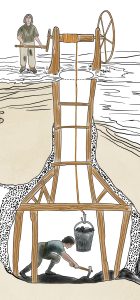 As the outcrops of coal were exhausted, shallow pits were dug to reach the seam to depths of up to 10 metres.
Our representation of a map of 1758 shows fields named “Pit Lands” bordering what is now Alfreton Road opposite the present Newton Link Trail. 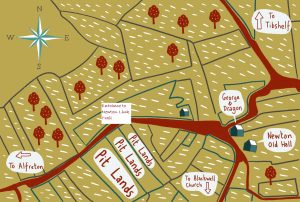
In these fields the coal seams were only a few metres below the surface. A small team of men, women and boys would have excavated what became known as “Bell Pits” because of the shape formed as the coal was extracted.
Digging Deeper
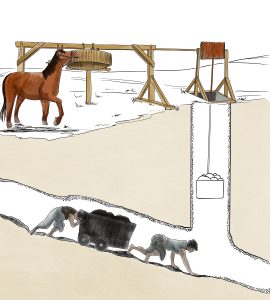 Eventually pits needed to go deeper to find the coal seam and more sophisticated extraction techniques were needed. As the vertical tunnels or shafts became deeper, the sides required wooden shuttering for support. The manual winch for drawing buckets of coal was replaced by a horse gin and then by steam engine.
It is thought that the “Drum and Monkey” Mine at Newtonwood Lane originally had a winch which looked like a barrel organ with handles which roamed the streets, it’s operator often accompanied by a monkey in uniform, hence the nickname The Drum and Monkey. This pit along with “Tommy Noonies” and Deadwater Mines in Newton would have been shafts like this with depths of up to 80 metres.
At the Drum and Monkey Mine in 1833 eight young men and boys were killed when the basket lowering them down the shaft crashed to the bottom.
Canaries in the Mine
Early miners used candles to illuminate their pit and accidents were common. When coalbed gases met a naked flame, explosions occurred.
 Caged canaries were used to detect dangerous gases, as their fast heartbeat meant they reacted to it quickly, fainting and falling off their perches. When returned to the surface the air revived them, and it’s said that some fell off their perches when there was no gas, just to get back above ground!
Canaries were effective gas detectors, but lamps were developed which reduced the number of accidents; These gave off light but restricted heat; one of these developments was Humphry Davy’s invention of the Davy Lamp in 1815.