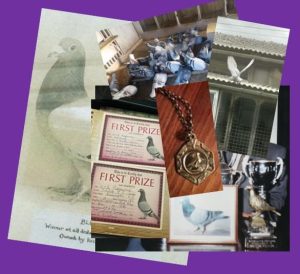
Homing pigeons are known to have been used to carry messages since the earliest times. In 776 BC the victors at the first Olympic Games were announced to cities throughout Greece by pigeons and Julius Caesar is said to have used them in his campaigns. In the 16th Century they conveyed messages across the Ottoman Empire and by the early 19th century they were carrying news across the English Channel. It is no accident that on 1815, word of Napoleon’s defeat at Waterloo was brought to London by pigeon.
The Coal Mines Regulation Act of 1906, limiting colliers to an eight hour day, created the leisure time needed to undertake the arduous task of rearing and training a pigeon.
Pigeon Keeping or “fancying”, was known as the “poor man’s racehorse.” It was a common pastime for many in the mining community providing an opportunity for the breadwinner to take time out from his gruelling work and family responsibilities. . Together with cheaper train travel, the art and science of breeding and caring for pigeon ( pigeon fancying) grew.
It was an expensive pastime due to the cost of buying the pigeon (£5 -£20), specialised feed, racing clocks and baskets. Some shared costs by banding together, and transported their precious birds in one wagon for despatch, and pigeins being shipped to the continent for release.
The pigeon loft was often not in the attic of the miners’ homes. The space was cramped and newer social housing forbade it! The pigeon loft was usually a homemade affair built from left over timber and brightly painted to attract the birds back home. For many it was sited in the backyard or allotment.
“The skies used to turn black ‘ere when the miners let their pigeons do a run out” said a Blackwell resident reminiscing upon the social history of the 1980s.
Breeding pigeons to race is widely remembered. At first it began as a simple 10 mile race back to the coop. First man and bird to arrive at the named shop or pub was the winner. It developed into a more competitive affair with large pots of prize money.
Trains were used to take the pigeons to the starting point; rings were attached to the birds’ legs to aid identification; specialised clocks were brought in to record the exact time of arrival’ and winners were determined based on average speed , rather than arrival at a second arbitrary location. We have gathered local stories in Blackwell Parish and have heard how young lads would put pigeons in baskets on their push bikes and take them to Westhouses train station to go off on their journey.
Breeding and showing pigeons remains a fiercely competitive pastime but it has shrunk drastically in it’s popularity in our local area since the closure of the pits.