William Downing of Newton Old Hall
There are many William Downings in the story, so I will refer to William 1779-1857 of Newton Old Hall as William (1)
According to the Grave in Newton Hall grounds, William (1) died in 1857 aged 77, putting his birth year at 1779/ 1780. There was a William Downing baptised 6th June 1779 at Blackwell, a second child to Joseph Downing and wife Ann.
William (1) ‘s father Joseph Downing had married Ann Machen (or Machin) at St Werburgh’s in May 1776. Their first son named William (0) was baptised on the 23rd April at St Werburgh’s and buried on 24th April 1777.
William (1)’s brother Samuel married Ann Handley at Tibshelf in July 1835, and in 1841 they were farming at West Pasture House Blackwell, and had a son William (2) born abt.1839. In turn his elder son William (3) took over the farm from his father until his death in 1917. He was a leading light in the St Werburgh’s congregation.
William (1) owned Newton Old Hall, according to a report on the interments in the grounds of the Hall, made by the Rev Kerry in 1890. It is unclear at what date William (1) took possession of the Hall. Rev. Kerry records that there are 3 stones, one marking the remains of William (1):
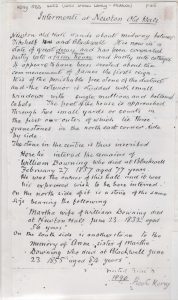 “ Here lie interred the remains of William Downing who died at Blackwell February 27th 1857 aged 77 years. He was the owner of this hall and it was his expressed wish to be here interred.”
A second stone is inscribed :
“ Martha, wife of William Downing, died at Newton Hall 1832 aged 56 years”
And a third is inscribed:
“ To the memory of Ann, sister of Martha Downing, who died at Blackwell June 23 1855 aged 84 years”.
The story told some years ago was that William (1) was married bigamously to 2 sisters, performing the marriages himself and that due to opposition from the Church he and the sisters could not be buried in the churchyard.
This interpretation is understandable given that all 3 are named Downing, but in fact Martha and sister Ann were daughters of Matthew Downing, William(1)’s uncle and so cousins of William (1). It was not until the beginning of the 19th Century that marriage to cousins was questioned and prior to then it was not an unusual happening, especially if money or property could thus be kept within the family. Martha and Ann were bequeathed £300 in their father’s will of 1799. Martha would have been a good catch for William(1) and Ann would have had the funds to buy Church Farm, where records show she was owner in 1827.
It would appear that within the Downing family there had been a split in religious belief in the late 1700s, and Martha and Ann came from the side of their mother Martha Clarke of Selston, who had been baptised at the Old Meeting Houses of Mansfield. William(1) is thought to have taken that route too after his marriage, and unlike his brother Samuel avoided the established Anglican church. William(1) and Ann had 2 daughters, Ann (1811) and Ellen (1812) and both were baptised at the Old Meeting House at Sutton.
It would probably have rankled with many that non-conformist Ann occupied “Church” Farm opposite St Werburgh’s. The St Werburgh Church Accounts for the rebuilding of the church taken from S Storer and HG Cresswell’s history The Church of St Werburgh Blackwell, contains an interesting entry of June 30th 1827: To Miss Downing ( a bill for land and Damages) ..£7 4 s..(ie for the quarrying done in her field),
The 1839 Tithe map records that Church Farm was owned by Ann Downing and occupied by William Downing, but also the Tithe shows that William (1) owned Newton Hall and was occupying that too. William(1)’s wife Ann had died in 1832, and presumably buried at Newton Hall.
In the first full UK census in 1841, William (1) is recorded as a farmer at Blackwell Parish, and the household consists of himself aged 60, Ann Downing 65 years, Ellen 25 years and Martha Adlington 4 years, Granddaughter of William(1) by Ann (1811) who had married Richard Adlington of Skegby.
In the census of 1851 the household consists of William (1) aged 71, Ann aged 77 and Ellen aged 37. Here Ellen is shown as daughter, and Ann is listed as Wife, but that is probably a mistake or assumption made by the census enumerator. Or maybe local gossip? No record can be found of a marriage of William(1) and sister-in-law Ann.
To date Ellen Downing cannot be traced in 1861; there is a record of an Ellen Heath with husband William farming at Tibshelf. William had lost his first wife in 1857, so it is possible that Ellen and William married between 1857 and 1861. There is a record of a marriage in Southwell district of Ellen Downing and William Heath, which probably confirms this.
Since both William (1) and Ann die in 1857 and 1855 respectively, they do not appear on the 1861 census, which shows the occupiers of Church Farm as Richard Wood Bagshawe (56yrs), his wife Ann (50 years) and Son in Law Richard George Adlington (11 years). This Ann was the daughter of William Downing (1), who had married Richard Bagshawe after the death of her first husband Richard Adlington of Skegby. Richard and Ann had 4 children, William Downing Adlington 1895, Martha Downing Adlington 1837, Sarah Adlington 1840, and Richard Geo. Adlington 1850.
The ownership of Newton Hall passed to Richard Downing Adlington on his grandfather William(1)’s death; The Hall was rented out, and poorly maintained until renovated and sold to Mrs Salmond in 1913.
The Downing family of Barrowby Lincolnshire descend from William(1)’s uncle and father-in-law Matthew, who appears to have farmed at Casthorpe and Barrowby in the 1770s where William(1)’s wife Martha was baptised, and where they married in 1809. That branch of the family has more William Downings!!
Tony Mellors 2026