Blackwell, a manor shared …Trussebut and Sulney….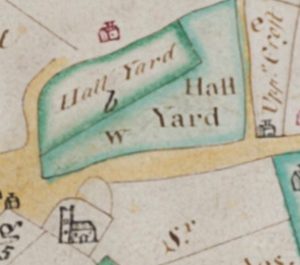
Medieval Hall in Old Blackwell in 1300s?
This extract of the 1758 map of Blackwell Parish shows that the field opposite St Werburgh’s Church was known as Hall Yard. The “w” indicates that piece of land at that time was owned by Sir Charles Molyneux of Teversal, who held half of the parish as lord of the manor. The other half was held by the Duke of Newcastle who sold to the Duke of Devonshire.
400 years earlier in the 1300s it is believed that there was a manor house on this site, owned by the de Sulney family of Newton Solney in South Derbyshire. The Woolley Collection researched by local historian David Coates has a charter written on 11th June 1369 by Sir Alfred de Sulney at Blackwell. The de Sulney family, originally from Soligny in France, had been granted lands by William the Conqueror, and there are records of Alfred being instructed in the 1320s to supply Derbyshire soldiers to defend the realm, and with his son in law Sir Nicholas Longford in the 1360s to supply Derbyshire archers; and for Nicholas to sail to Aquitaine to support John of Gaunt in the fight against France. It would appear that Nicholas had taken over the manor of Blackwell with his wife, Alfred’s granddaughter Margery.
There had been two lords of the manor of Blackwell from the 12th Century, half share being known as Sulney and the other Trussebut; The Sulney connection is known but to date the Trussebut name remains a mystery. Local Historian Edgar Storer recorded that there had been a stone marker near the Cragg Lane entrance to what was Hall Yard and is now known as Church Farm. The stone was engraved EC for Earl of Carnarvon and DD for Duke of Devonshire, who were the lords of the manor from the 18th Century.
 We cannot know what the Old Sulney Hall looked like or whether there are parts still within the Church Farm Building, but Norbury near Ashbourne’s Old Manor was built about the same time so may give a guide.