Huge Changes in 10 years
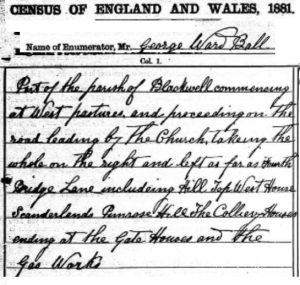 The population recorded in the 1881 census and described here, necessitated the employment of 2 enumerators, George Ward Ball for the area listed in the image here, and described as :
Part of the parish of Blackwell commencing at West Pastures and proceding on to road leading by The Church, taking The whole on the right and left as far as Forth Bridge Lane including Hill Top, West House, Scanderlands, Primrose Hill, The Colliery Houses & ending at the Gate House and the Gas Works.
George Ward Ball was the son of Hannah, recent widow and Inn Keeper at the Robin Hood Inn in Old Blackwell. George was the Parish Clerk and Collector of Rents and Rates
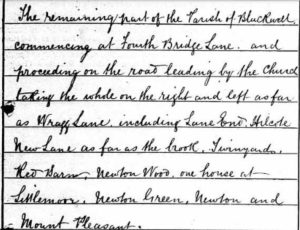 The remaining part of the Parish began from Fordbridge Lane ,and included Old Blackwell, Hilcote, Twinyards, Red Barn, Littlemoor, Newton Green, Newton and Mount Pleasant; this part was enumerated by Peter Bansall, son of Tamah Bansall and Joseph Allen, and whose family will feature in the Framework story in the “Industry” pages of this site.
Households and Population
The 10 years between 1871 and 1881 was when a huge transformation of the parish took place, brought about by the sinking of A Winning Colliery and the construction of housing for the miners’ families.
In the village of Blackwell as we understand the area now, there were 2 properties in 1871, Hill Top and Scanderlands, and by 1881 there were 201; there were about 100 new at the Colliery Rows and the remainder new on Primrose Hill. About 17 of the latter were still unoccupied, presumably just completed. There were now 1117 people here, in 184 houses.
At Newton 89 new houses have been built, 26 of which are uninhabited at time of census count. These were chiefly in what was known as Newton Green, which was the area along Main St. Mount Pleasant appears for the first time with 8 new houses, 5 of which were unoccupied. Were these perhaps Winfield Cottages? Newton, Newton Green and Mount Pleasant had a population of just under 683 in 102 houses.
Hilcote was also seeing development at that time, with 23 new houses, 11 unoccupied, and a total population of 264 in 37 houses.
Old Blackwell and Westhouses remained almost unchanged in housing and population.
Throughout the parish, housing had increased from 93 to 403, and the population from 537 to 2184, a fourfold increase. The average number of people per house was 6.4.
Occupations
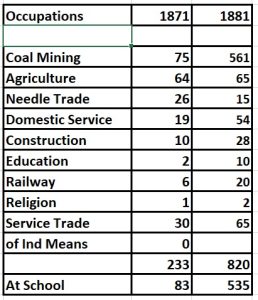 The chart here shows the numbers employed in the various activities; Note especially the increase not only in coal mining but in those employed in the services required by a growing community. We have our first Council employee, George Ward Ball, and even an artist, Rachel Guy, who describes herself as a “Paintress” . Similarly we have a “Weaver”, and as Framework Knitting continues to decline, our description changes to Needle Trades in anticipation of the growth which will develop in the future. The increase in those employed in Construction indicates continuing growth in the house building programme.