Pippa Gibbs talks through her process of developing the painting of Main Street
12th August 2025
Initial consultations – Tony and Geoff talked me through the research and photographs collected by the community and also gave me a guided tour of the street. This enabled me to form a mental picture and understanding of the buildings that used to be on the street, how they were used and how the remaining buildings have changed over time. Most importantly I wanted to understand and get a sense of how people lived here in the mid-20th century, and what they might have seen in the street when going about their daily business.

John Peak kindly gave me a guided tour and lots of background information about his wonderful AEC Regal Mark 111 that used to come through the village. It will be painted on the left side of the canvas, coming around the bend into the village giving a three quarters perspective. I imagine it starting its’ journey down Main Street.

14th August – The canvasses have arrived – this is what 5 metres (or 507.5 cm to be precise) of blank canvas looks like. Setting up the composition of the whole 5 metre frieze took me longer than expected, as I wanted to create balance across the whole piece. This is also where I really appreciated the digital images produced by Tony Mellor – these were my starting point for composing the artwork.

18th and 19th August
The canvasses weren’t blank for long as my first task was to draw the entire street by hand in graphite pencil, including 149 house windows, 63 chimney stacks, 17 shop windows and 66 front doors. This is when the attention to detail, perspective, scale and composition will pay off as the project progresses. I used a rubber resist liquid to paint onto every window and door – this is to keep the canvas in these areas fresh and white until I was ready to paint in those details.

5th September
After 5 hours working out the composition and 10 hours drawing all the buildings and detail, the frieze was ready for underpainting. I wanted to do this across the whole 5 metres at the same time, so the underlying colour is consistent across the whole length, giving a visual coherence to the piece.


The painstaking process of painting the layers of detail begins. The more layers I can do, the more detail there will be. I started on the centre canvas first, so that I have the most time to build up the detail. I worked on each canvas over and over again, each time more detail is added. I researched and drew in the details of the vehicles, and I gradually added more people in sections of the frieze.


I used the photographs, oral histories and information collected by the community to develop the figures and shop fronts. I drew the people in pencil, then painted them white before adding the ink and paint details:

On 15th September, I met with the sub-committee for a review of progress and to ensure they were happy with how things were going. The feedback was positive, along with some corrections and adjustments needed. We also had a conversation about adding an indication of the railway, and I was given photographs and a map to help me understand where this used to be. I drew and painted a coal train at the end of the canvas, which hints at the industrial context of much of the village.
Throughout September, I continued gradually layering up the detail and painting in the window and shop front details, until eventually the frieze looks like this:


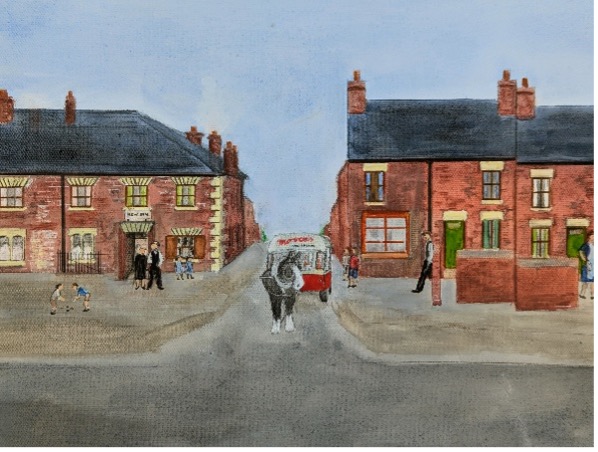

It’s ready to share with the Newton community at the event on 19th October.
Im looking forward to it!