We were delighted to be able to take a community trip out to Ruddington last week to visit the Framework Knitters Museum.
A group of mixed ages from across Blackwell Parish gathered at Newton Community Centre to take a mini bus the short journey towards Nottingham to discover the one of the few places left where you can experience the living and working conditions of Victorian craftspeople.
The museum sits on a small site but transports you back in time to another world of manual labour and cramped working conditions surrounded by rustic, attractive gardens and handmade trimmings.

We had made a group booking in advance and were greeted at the door and guided into the school room where we received an introductory talk and video, setting our scene for the time and place.

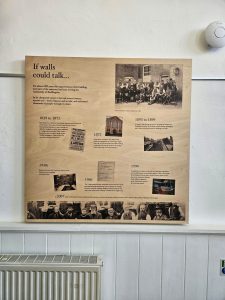


We then moved into the courtyard where we split into smaller groups and were allocated guides who would show us through the different areas of the museum. We hadn’t expected guided tours so it was a pleasant surprise to be shown around by such knowledgeable and dedicated volunteers.


The workshops:
We were shown into the small working buildings where row after row of machines were squeezed in. We had anticipated they would have been operated by women and families like in the cotton spinning mills but we discovered these machines were mostly operated by men as there was little need for small hands or working underneath. In the family set ups it was the men working the machines to make the stocking cloth while the women embroidered the designs and sewed the seams turning them into stockings.
The machines require a repetitive movement of peddles and levers to move the rows around in a way that seemed to me a little like learning to drive a car where it becomes muscle memory to do actions in sequence and in relation to other movements.
Our guide explained about how the machines had been invented and the needle mechanisms developed over time .
This photo shows the principle of each hook on the machine at large scale and the movement of the yarn around the hook.
While this photo shows how the hooks could be operated in groups 
In the actual machines the hooks were much smaller and in long rows.

We learnt about the types of knit stitches they created and the stockings that were produced – in an era when stockings were standard dress for the wealthy.

We also learnt about how machine lace making was discovered and shown the complicated processes involved in dropping and re-catching loops in perfect patterns. It would have been a hard job working in non insulated buildings in all weathers, often by candlelight and getting paid by the piece not by the hour.
Look at this clever system for focusing candlelight onto a machine!
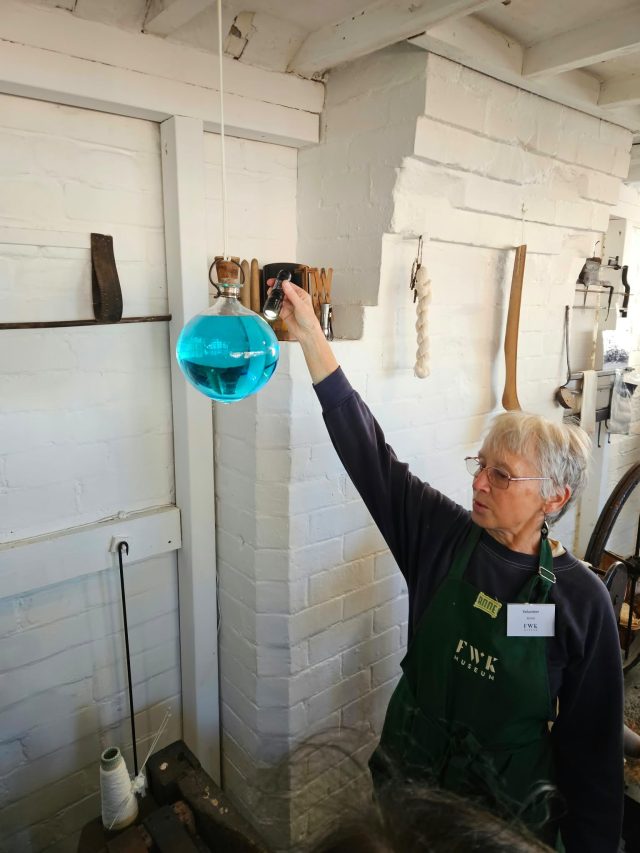

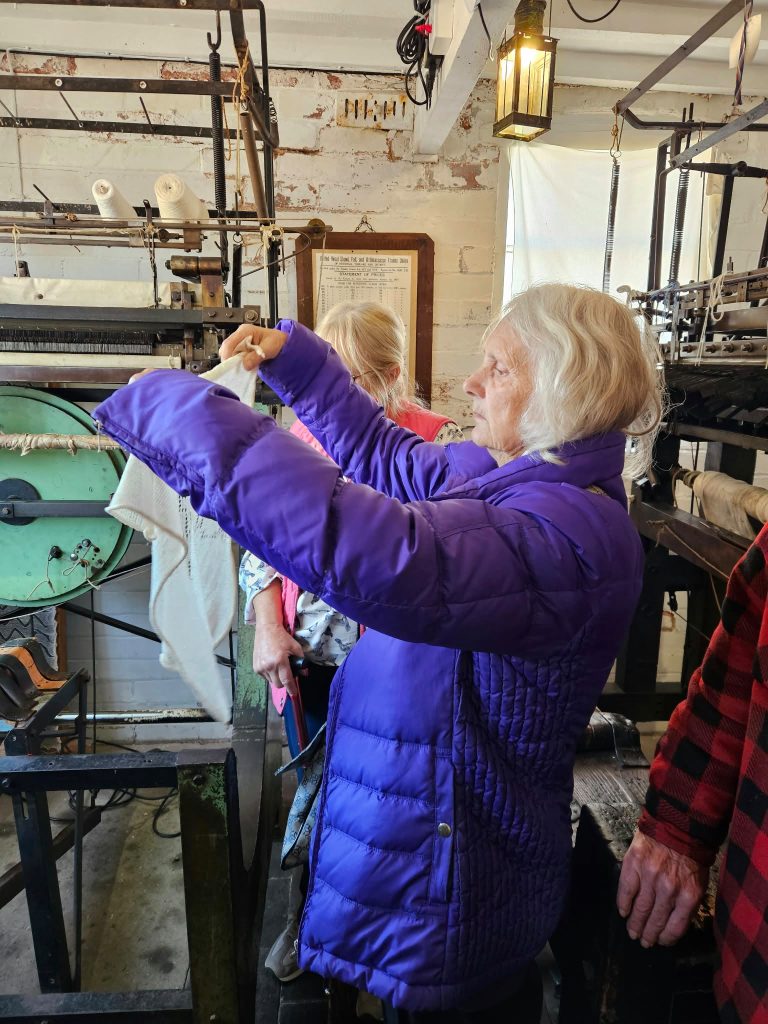
Some of our group had a try at knitting themselves while others busied themselves reading all the information boards and checking out the different displays.

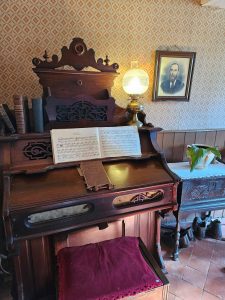
The other buildings of the museum showed the living conditions of both the workers and the management families and we got to explore the different rooms of houses and offices, outhouses and toilets / pig pen – ew!


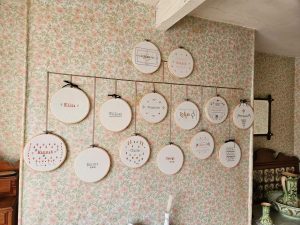
Management rooms were more spacious and comfortable but they still didn’t have running water. Families were huge, with the mother of this family giving birth to 12 children. The black ribbons signify children who sadly died in childhood.

After our highly informative tour we headed back to the school room for a buffet lunch laid on by the onsite cafe.
Sandwiches and cake filled us all up nicely and we chatted about what we had seen. It was nice to sit and take in what we had learned and share snippets with each other.
After lunch we had a short time to browse the gift shop and then back on the mini bus for our return trip.
Everyone agreed we had certainly packed a lot into our day and the museum had packed a lot into our minds.
